Full-Stack Leadership: New book published: You are invited to the launch of the book

Full-Stack Leadership: New book published: You are invited to the launch of the book

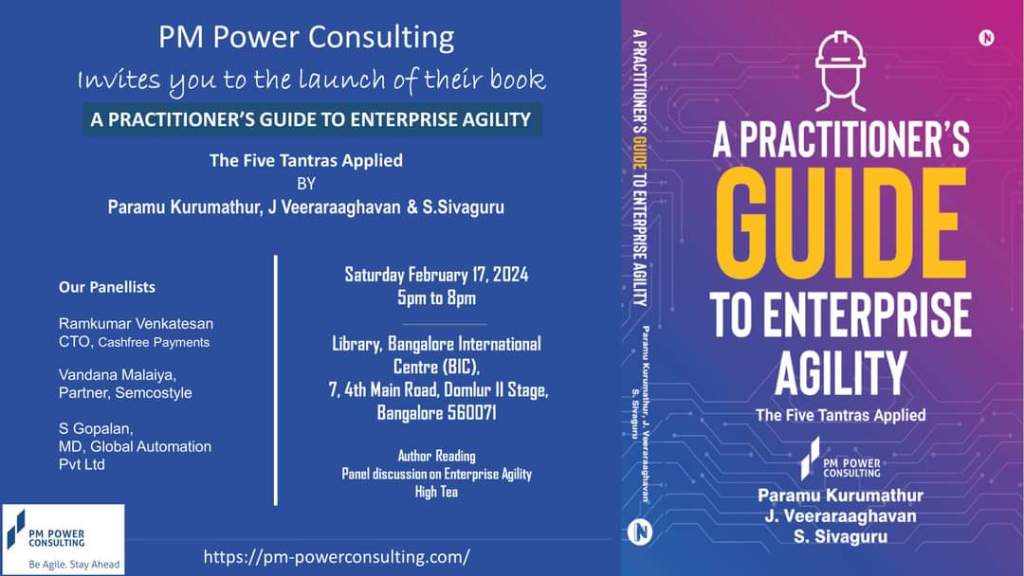
This is to announce that I have published (as part of PM Power Consulting’s offerings) a new book called Full-Stack Leadership.

The book is being launched on August 22, 2025. Please click here to see details of the launch. In this site you can start off by playing the Full-Stack Leadership game, and explore the book in details using an AI companion to the book.

The book is available for purchase at the sites mentioned below.

FlipkartAmazon.comAmazon.inNotionpress

For a synopsis of the book click here

For endorsements of the book from industry experts click here

Book Launch. You are invited

Book Launch. You are invited

If you are a stakeholder or change agent looking at steering an organisation through an Agile transformation journey, this book is for you. It examines the specific practices that need to be adopted and enabled within the organization to fully realize the Values/Tantras of Agile. It does this by looking at the outcomes expected/desired by the three main stakeholders of a successful enterprise – Customers, Associates, and Shareholders – and describing the practices that drive these outcomes. The contents of the book are based on the authors’ discussions with various industry leaders who have implemented, driven or guided Agile transformations and with PM Power experts who have more than 1000 years of collective experience in the area. The outcomes and practices are presented as responses to certain situations and episodes that have arisen in a fictitious organisation that is a combined entity embodying various organisations that PM Power has worked with. The conversational style and the touch of humour makes reading easy.

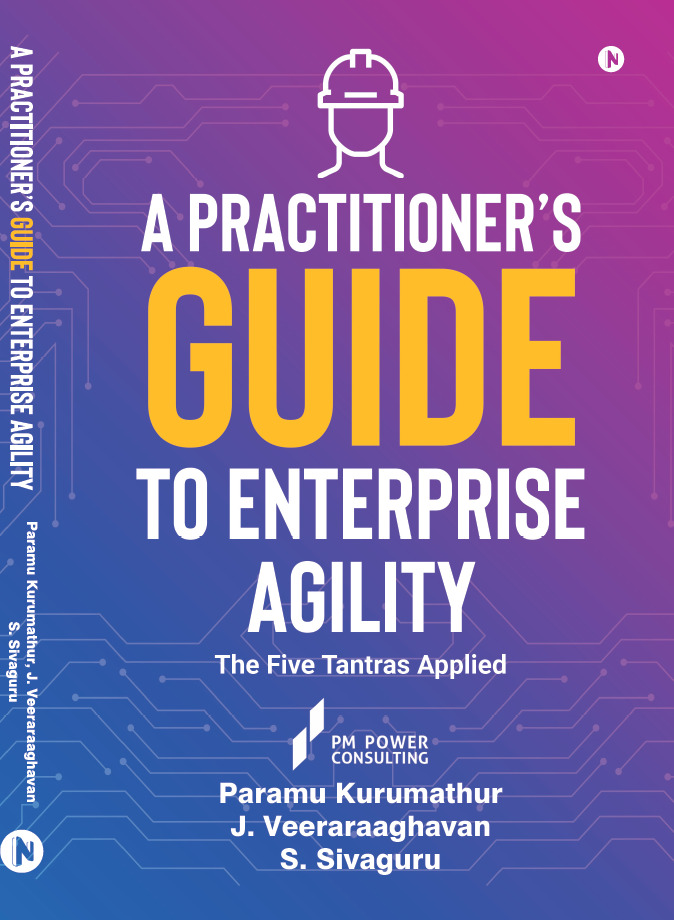
My upcoming book has been renamed. Here is the new cover. The contents remain the same.

My upcoming book has been renamed. Here is the new cover. The contents remain the same.

Click on the links below to visit summary pages of the book

Summary

Summary – Section 1

Summary – Section 2

Summary – Section 3

Summary – Section 4

Summary – Section 5 (1)

Summary – Section 5 (2)

Summary – Section 6

Summary – Section 7

Summary – Section 8 (1)

Summary – Section 8 (2)

Summary – Section 9

To write or not to write…

To write or not to write…

Do you have to be an expert to author a technical book?

A fable:

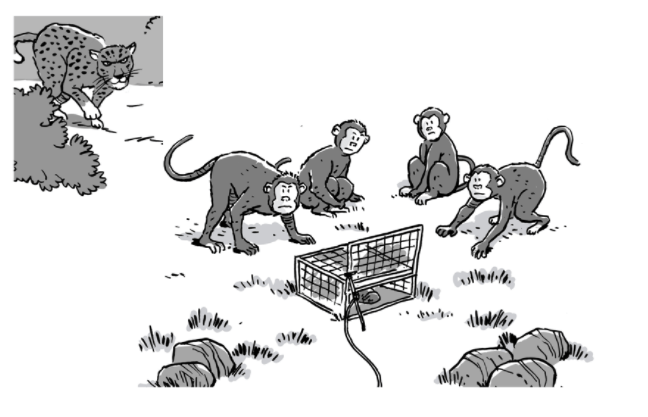
Once in the Champakaranya forest there lived a troop of monkeys. The head monkey was an expert at detecting any approaching predator, whether it was an eagle in the air or a leopard on the ground, and of any monkey-traps on the ground. However, the head monkey thought it was undignified of him to shout even when he sensed that danger was nearby. He expected the troop monkeys to observe him and hide or run away when he did. But, of course, this was never perfect. The troop lost many a member to predators and traps because they did not get an early warning of the danger.

Over time, a young monkey started learning the techniques to sense the approach of an oncoming predator and any traps set in the ground. He was not an expert as the head monkey was, but as soon as he sensed that danger was nearby, he shouted and alerted the other monkeys. Of course, he made mistakes and sometimes gave false alarms. But as time passed, he got better.

The monkey troop was very happy and decided that it was better to have as head a semi-expert who informed them of oncoming danger rather than an expert who kept silent and kept the knowledge to himself. So, they dethroned the head and made the young monkey their head.

Note: This fable and accompanying picture are taken from the book, The Five Tantras of Enterprise Agility, published by PM Power Consulting.

Experts in a field pass on their knowledge to others in various ways. Some consult, some coach, some give talks and some write books.

But what if you are not an expert?

I know many people who hold themselves back from writing and authoring books in technical areas because they feel that they are not ‘experts’ in the field. They perhaps feel that they are frauds, writing about an area that they are not at the top of. Another fear many people have is that if they are not ‘experts’ and write and publish a book, they may be caught out when somebody opens a discussion on the topics covered in the book.

[Let us get the difference between an author and a writer out of the way. A writer is someone who writes anything: a log, a book, any sort of content etc. A journalist is a writer. An author is a person who has written and published a book that is credited to their name. The author owns the copyright to the book. When I use the term ‘write’ a book, I mean writing it with the intention of getting it published, with the writer getting the credit and owning the copyright.]

I think that these fears are unfounded. If you can write well, you can write about anything, provided you get inputs from experts, either by interviewing and interacting with them or reading their published works. Remember a book is not like a research paper. In a research paper you are putting forward new ideas or coming to new conclusions. But a book’s purpose is basically to put into easy language known ideas and conclusions. [Indeed, if the book being written is on a completely new idea, and there are no experts around, then you better be the expert also.]

But the reverse may not be true, even if you are an expert, if you cannot write well, you cannot write a book on the topic. 

With apologies to the good bard, I write good words while others think good thoughts.

The basic idea of writing is to share with people what you know and what you can get from others. This is the basic dharma of a writer: inform the reader. As long as you are able to do this, whether or not you are an expert, you are OK. The real purpose is connecting with your readers and informing them. Of course, one thing that is important to note is that as a writer you can form your own opinion about the subject and put that forward too. You don’t have to be restricted to what ‘experts’ have put forward.

Another idea of writing a book is that even if you are not an expert when you start writing the book, by your association with experts while writing the book, you become an expert yourself! [This aspect, by the way, should put to rest fears that you may not be able to answer questions on the topic.] What, after all, is an expert? Lexico.com powered by Oxford defines an expert as A person who is very knowledgeable about or skilful in a particular area. It is not clear how much knowledge you need in a particular area to be called an expert. The expert is a relative one. Writing a book on a topic will certainly take you very far into being an expert in the topic.

So, I say: Write, if you can, whether you are an expert or not.

But whoever is writing a book, one thing is clear. Writing a book takes a lot of commitment. Only a writer will know the amount of work involved in writing and getting a book published. For every book that is written and published there may be hundreds that are left incomplete.

[Note: Writing a book is only one way an expert informs others. There are many other ways, as I said before, like coaching, consulting, speaking and so on.]

Calendars of India: Theory and Practice – Book in the Workshop

Calendars of India: Theory and Practice – Book in the Workshop

Suggestions for topics for inclusion (or exclusion) are welcome.

(This book is in the workshop. I am right now gathering materials for this book. Am looking at six to nine months for the completion of the book. Then another year for publishing it?)

A synopsis

A YouTube version is available here.

(Note that these are the first thoughts. Subject matter [and title] may undergo changes as time passes. Any suggestions in this area are welcome.)

These days, there is an upswell of interest in Indian mathematics, Indian astronomy and Indian religions, observances and festivals. Most of these observances and festivals are celebrated on particular dates of one calendar or the other. For example, the birthday of Lord Rama, one of the most important deities of veneration among Indians, is celebrated on the ninth day of the bright half of the month of Chaitra. What does that mean?

In India, while we follow the western (Gregorian Calendar) for civil and official purposes, at home, for religious and liturgical purposes we follow a myriad of calendars based on the region we are in, based on our religion, our community etc.. This gives rise to many questions that an average person is faced with:

  • Why is Lord Krishna’s birthday celebrated on different dates in different parts of India? Why even in the same place, Iyers and Iyengars have different dates for Krishna’s birthday?
  • Why do we hear people saying “While my actual birthday is today, my birth star / birth tithi is next week” What does it mean when someone says my birth star is today?
  • Do time zones make a difference to the star you are born under? [That is, does a person born at the same instant in the US and in India fall under the same star, tithi etc?]
  • Why is Makar Sankranti which is supposed to be the start of Uttarayana, celebrated nearly 24 days after the actual event of the start of Uttarayana? What is Uttarayana?
  • Why are there so many year-beginning dates in India? How many “new-years” are there in India and why?
  • How are months reckoned in the various calendars? Why do some months in some calendars have 32 days?
  • What is the concept of an added month? That is, why do some years have 13 months? And rarely only 11 months?
  • How do Christians fix the date of Easter?
  • Why does the Muslim festival of Ramadan migrate across the seasons? That is, why does Ramadan come sometimes in summer and sometimes in winter?
  • Why do Shraaddhas (death anniversaries)  and birthdays of the same star or tithi fall on different days?
  • What are the five “limbs” of the Panchanga? And what is the significance of each of those?
  • What is Raahu Kaala? And why is it bad? What are the other Kaalas?
  • What is a “muhurta”? What do we mean when we say that the “muhurta” for a wedding is such and such a time?
  • What is the meaning of a birth chart and how do you cast it?
  • Does the day begin at sunrise, sunset or any other time?
  • What is the effect of an eclipse?
  • What is Kali Yuga and Kali day number?
  • What is the history of the calendar?
  • What is the astronomy behind calendars?
  • What are the various calendars followed in India and how are they organised?
  • What is the meaning of a solar calendar, a lunar calendar, a luni-solar calendar etc?
  • Why don’t we have leap years in Indian calendars?
  • Why are there 30 tithis but only 27 stars?
  • What is yoga in the panchanga?
  • Why is there a difference between the beginning and ends of the birth signs (Aries, Taurus etc.) between western and Indian systems?

These are some of the kinds of questions that people of India grapple with every day when it comes to celebrating any religious festival.

This book Calendars of India: Theory and Practice strives to answer all the above questions and do much more.

The first part of the book looks at the origin of calendars and how calendars are intimately tied to the positions of the Sun, the Moon and the planets. It then goes into the astronomy of calendars, touching upon the following, among others:

  • The Solar System – the revolution of the earth round the sun, the movement of the sun, the moon and the planets as seen from the earth; 
  • The rotation of the earth – time, reckoning of days and hours minutes etc.
  • Sunrise, sunset, equation of time, mean solar day, sidereal day
  • Coordinate systems, the ecliptic, celestial equator, equinoxes, solstices; precession of the equinoxes and ayanamsa; obliquity of ecliptic, nutation etc. etc.
  • The year, days from equinox to equinox, the tropical year, the anomalistic year, the sidereal year etc
  • Days of the week
  • The sky, the stars, constellations, signs, the path of the ecliptic, the position of the sun
  • The moon, position of the moon, the phases of the moon and Eclipses
  • Notes on Indian astronomy, the various siddhantas (Surya Siddhanta, Brahma Siddhanta and Arya Siddhanta) and the various karanas associated with them, 
  • Epochs, Julian Day and Kali Yuga and Kalidina.
  • The changing sky and star orientations over the ages.

The second part looks at the Gregorian Calendar, its evolution and the logic behind it with respect to the astronomy discussed in the first part. The Gregorian calendar serves as a baseline for looking at other calendars. It also looks at the history of calendars.

The third part looks at the basic logic of Indian calendars and how the astronomical facts discussed in the first part affect them. Some of the topics discussed in this part are:

  • Types of calendars and the logic behind them – Solar calendars, lunar calendars, luni-solar calendars, equal-month calendars etc.
  • Solar months – stars, day numbering/naming, sankranthi, rule for beginning a month
  • Lunar months – Amaanta (new-moon last) and Puurnimaanta (full-moon last) systems, half-months/pakshas, tithis, day numbering/naming, month names, added (adhika) months, suppressed (kshyaya months), day additions, day suppressions, day repetition, length of months, adhika, kshaya tithis etc.
  • Lunisolar month 
  • Yuga, kalpa, mahayuga etc. samvatsaras, cycyles, kshaya and adhika samvatsara jupiter cycle
  • Mentioning dates; 10th day of the 8th month or 10 days after 8 months. Count up from the first of the month (like we do now) or count down to an event (like the roman counted to the ides etc.)

The fourth part looks at the various calendars of India and how they are organised:

  • the various Indian Panchangas and calendars – Kollam era, tamil era, vikrama era, saka era, gupta, bengali, Kannada/Telugu era, oriya, muslim era, maratha and many more
  • Calendars during the Vedic times
  • Chinese calendar, iranain calendar
  • Mathematical calendars (computed purely mathematically) and astronomical calendars (based on the position of the sun, moon etc.) ; Observational calendars (based on sighting of moon etc.)

The fifth part looks at the mathematics and astronomy (not predictions!) behind the astrological systems of India

  • Birth charts, Rashis (signs), positions of the planets, what is Rahu and Ketu, What is Gulika etc. effect of time zones
  • Navamshas and other amshas
  • What is ascendant (lagna)
  • What is the meaning of houses, aspects etc.
  • What is retrograde motion of planets?
  • What are muhurtas (times, good times etc.), Raahu kaala and other kaalas etc. dashas; balance of dashas

As I mentioned before, these are initial thoughts. As I get more and more into details of the book, subject matter and the order and format they are presented in may change.

The Five Values (and the Ten Principles) of Writing as Enjoyment

The Five Values (and the Ten Principles) of Writing as Enjoyment

It is the dream of everyone to write a book. When you are young, you have great visions of becoming an author. You feel that you can make a living writing a book, rather than by doing a regular day-job. But, as you get older, your romantic notions of writing a book to be seen as an intellectual start fading. If you have not written a book by the time you are 35, it is highly unlikely that you will write a book for the next 20 years. You have too many mundane things to worry about. As a householder it is difficult to write a book. This is what I feel. Don’t ask me for evidence of this.

Now, once you cross 55 and start thinking about retiring from your regular-day job, your writing urges start coming back. But now, you have more lofty ideals. Rather than being seen as an intellectual, you want to ‘give back to the world’. You want to put your experiences on paper so that, hopefully, others can benefit from them.

I have now written and published three books. The fourth one is doing the round of the publishers looking for a home. My first book was published when I was 62. So I fall into the second category. Having written four books, I have come to some conclusions about writing. This ‘manifesto’ is the manifestation of those conclusions.

I will enunciate five values and a set of principles that can form a guide for anyone, of the first or second category, to start writing a book. I call this method of writing – following these values – as ‘writing as enjoyment’. These values may seem contrary to all the management principles you have learned so far, contrary to all the advice you will find on writing books, but so what?

I want to hurry here to add that all these values and principles are only for unknown writers like you and me. They are not for writers of the ilk of John Grisham or Amish Tripathi – writers whose books become bestsellers while even in the womb. And they are not for those, who though they are first time writers,have otherwise made a name for themselves and whose first book will sell automatically. A person like, say, Nandan Nilekani.

So, here goes:

In my experience as a writer, I have come to believe in the following values and principles as paramount in ‘writing as enjoyment’.

Note: I have presented the values as ‘something over something-else’. You find that what is on the right-hand side is what is traditionally and normally presented as important for writing a book. I am not saying that there is no value in what is on the right-hand side. What I am saying is that there is more value in what is on the left-hand side. The ten principles outlined, if followed, by you as a writer, will help you live the values mentioned.

Values

  1. Writing the book over publishing the book
  2. Enjoying the writing over enjoying the end product
  3. Starting the writing over planning for the writing
  4. Writing for yourself over writing for others
  5. Living to write over writing to live

Principles

  1. Do not be constrained by what you think others want you to write
  2. Approach publishers only after completing the writing of the book.
  3. Write, write, write; do not worry about the result.
  4. Write, read, re-write, re-read, correct, re-write, re-correct… 
  5. You can start your jogging regimen even in your old shoes
  6. Don’t be a word counter.
  7. Do not let others manipulate your idea
  8. Don’t worry about the audience.
  9. Do not expect to make a lot of money writing.
  10. Write, because you have a message for the world.

Explanation of each value and principle

The first value is: Writing the book over publishing the book

What this value means is this. When you write a book, do not write it with the aim of publishing it. Of course, you may ask, then why the hell am I writing it? Not for keeping it among your hidden files hoping that your great-grand-child will one day find it and publish it. But, if you focus on the publishing aspect of the book, you will be constrained by what publishers look for in a book – market value and sales potential. You don’t want that to happen. You want to let your free spirit flow into the book. You can worry about market needs and sales potential later. So, the first principle that goes with this value is this: Do not be constrained by what you think others want you to write. You are writing for yourself. Not for others.

If you are lucky, a publisher may accept your book and give you an advance, even though you have not even written a quarter of the book. Maybe the publisher likes the genre, maybe they like the plot, or they are just feeling generous. The problem here is that now you are committed to a date, a particular storyline, a particular position etc. The publisher may, and it is their right to, start dictating terms. You may even need to change the entire plot. My suggestion is this. Look for publishers only after completing the writing of your book.  I know it is difficult to say ‘no’ if some publisher offers you a tidy sum and a promise to publish your work. Though the chances of such an offer are as low as th at of your going to Mars one day, if you do get such an offer it will be difficult to resist it. Then you will have a trade-off decision on your hands. So my next principle is this: Approach publishers only after completing the writing of the book.

The second value is: Enjoying the writing over enjoying the end product

Most writers and authors have grand visions of the end-product. A book that becomes a best seller and sells in the millions, the author a rich man etc. While writing my first book, I would constantly go into a dream, thinking of my book breaking all records. Remember only a small percentage of books become successful. So, the chances of your book breaking into the big club are very slim. But, don’t lose heart. You are in it for the writing, not the publishing. Enjoy writing the book. Enjoy the journey more than arriving at the destination. In fact, what you will find is that, while you were excited to no end while writing the book, once it is over and published, you suddenly feel a void, and no sense of achievement. As Krishna tells Arjuna in the Bhagavad Geeta, ‘your right is only to the work, not to the result’.  If you concentrate on writing, rather than on what the end-product will look like, you may end up with a good book. So, the next principle of writing is: Write, write, write; do not worry about the result.

Does this principle mean that you type out letters randomly on the keyboard and hope that a book will form, as promised by the infinite monkey theorem? No, no. As your book develops, you enjoy reading and re-reading it as you write. While you write about a character here, you should make sure that you are not contradicting something said of him before. So, read, re-read, write, re-write, correct, re-correct as part of the writing process. Consistency, correctness, characterisation, setting, all these will and need to alter as you go along. You may get new ideas as you are writing, you may find new facts as you are writing. All these may need to be incorporated. Enjoy this as much as writing new chapters. So, my next principle is: Write, read, re-write, re-read, correct, re-write, re-correct… 

The third value is: Starting the writing over planning for the writing

Towards the end of every year, around Christmas time, you will find thousands of people buying new running/exercise shoes. They have all made the resolution that they will start an exercise and jogging regimen come the new year. So they buy new shoes, new gizmos that measure how many steps they have jogged, new shorts etc. Then the new year arrives and they find one excuse or another to not jog or exercise. The new equipment? Sitting in a corner! The main thing is starting your exercise or jogging regimen, even with old shoes, even if it is the middle of the year;  not planning for it. And remember it is more important to run your steps than counting how many you have run.

The same principle applies to writing. I know people who resolve to write a book, and buy books about writing, buy a new laptop, even buy a new chair. Forget all this. Start writing, even if it is on your old laptop. Everything else comes after this. So, the next principle is: You can start your jogging regimen even in your old shoes

And don’t worry about the size of your book. When I was writing the first book, I used to brag about the number of words I had written so far and the fact that I would reach 90K words. It is more important to say what you want to say, not saying it in as many words as you can! In fact, don’t worry about the number of words, don’t count them till you have finished the book. As Kenny Rogers says in the Gambler, “You never count your money when you’re sittin’ at the table. There’ll be time enough for countin’ when the dealin’s is done”. And, many people tell you, ‘write at least 500 words a day’ or some such thing. Don’t worry about all that. Write what you can, when you can. So the next principle is: Don’t be a word counter.

The fourth value is: Writing for yourself over writing for others

You will hear people telling you, get feedback, get feedback early. I don’t believe in that. You are writing the book for yourself, not for others. If it makes others also happy, and therefore you make some money, see it as a by-product of the process by which you kept yourself happy – by writing for yourself. Of course, you do want some feedback on spelling, consistency etc. but not on your idea. Your idea is yours. You are committed to it. You believe in it. Don’t let anyone else say otherwise. You want to put your message across, not someone else’s. Sure enough publishers may not publish it. So what. These days you can self-publish. So, the next principle is: Do not let others manipulate your idea

One of the important advice that is given to aspiring writers is ‘Research your audience’. Find out what readers want, find out how they have reacted to books of a similar ilk, is there a common area where what the readers want overlaps what you want to write about. All this advice is okay. But, again, it detracts from your idea and from what you want to say. Did Kafka or James Joyce research their audience and figure out what the audience wanted? Of course, I am not saying that you or I are at Kafka’s level, but the general principle holds. You write what you want to write, not what the audience wants to hear. So, the next principle is: Don’t worry about the audience.

The fifth value is: Living to write over writing to live

You are a writer because you like writing. You find great satisfaction in writing. You are living to write. But, if your motivation is making a lot of money, you are in the wrong business. As you may already know, only a small percentage of books become commercially successful. If you have a family to support, don’t think that you can do it by writing. Find yourself a regular job. Of course, there are many professional writers who make a living out of writing. Writers of TV serials, for example. Many of them regularly belt out the next part of a 7000 episode serial every day. But, it is like a day-job for them. Shakespeare wrote his dramas simply to make money. But since you cannot, and may not, want to be a serial writer, you may need to keep your job, unless you are retired, like me. But this does not need to stop you from writing. You can write in the evening to unwind. See writing as a relaxation after work. So, the next principle is: Do not expect to make a lot of money writing.

You are an important person. Do not underestimate yourself. You have many things to tell the world. You have many new ideas, many new concepts. Who but you, will bring this to the world?,You are born to spread your message. So, write about your ideas. Let the world know what your thoughts are. You are born to write. So write. The next principle therefore is: Write, because you have a message for the world.

Conclusion: I think great and successful writers have followed these values and principles when they wrote their books. A word of caution though. The converse need not be true. All who have followed these principles have not become great writers. There is always percentages at work here. You have to realise that when you sit down to write.