
A Practitioner’s Guide to Enterprise Agility – The Five Tantras Applied
A Synopsis

An enterprise exists to deliver value to its stakeholders (Customers, Associates and Shareholders). Continuous delivery of value to stakeholders is the mantra that industry leaders now chant in their offices all day long. Now, how do they deliver this continuous value?
People are now sold on Agile as the approach to develop products and services in a way that will deliver value continuously. Time and again, Agile has proven to be more flexible and effective in responding to change than other, traditional approaches. With Agile, customers and stakeholders get the best outcomes as they are engaged in the process of absorbing continuous value.
PM Power’s previous book, “The Five Tantras of Enterprise Agility,” introduced PM Power’s values or Tantras of Enterprise Agility – 1. Focus on Customer Outcomes Over Backlog Burnup; 2. Self-organised Teams Over Supervised Teams; 3. Transformational Leadership Over Directive Leadership; 4. Experimentation and Learning Over Planned Improvements and 5. Lean Thinking Over Productivity Measurements.
However, that book focuses mainly on the concept of the five Tantras and explains what they mean. It does not delve into the details of the implementation efforts and the practices on how to realize and sustain these Tantras.
The goal of this book, “A Practitioner’s Guide to Enterprise Agility: The Five Tantras Applied,” is to address this gap and explore the details of the implementation of the five values. In fact, there has been a demand from our clients for such a book.
This book looks at the outcomes expected/desired by the three main Stakeholders of a successful Enterprise – Customers, Associates and Shareholders – and at the key indicators of these outcomes; the practices that drive these outcomes and how they influence the outcomes by mapping the relationships between the outcomes and the practices; and the implementation strategies of these practices. A schema of the relationship between Outcomes, Indicators, Practices and Tools relate to each other is given below.
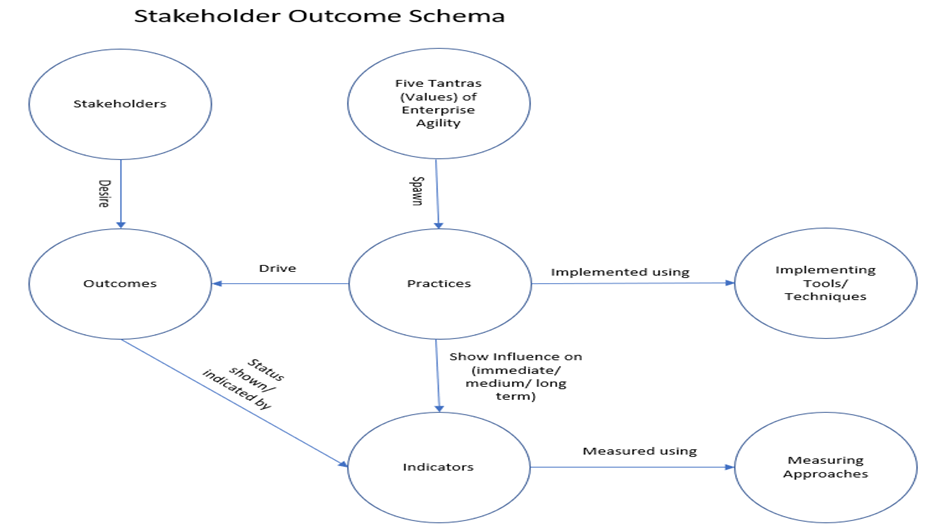
The authors of this book have had many discussions with organizations that have successfully (or not so successfully) implemented Agile. The experiences of these organizations and the experience of the authors and other PM Powerians working with these organizations have been captured in the book. The contexts of the outcomes expounded in the book are explained using real-life episodes from these organizations.
In all, the book details ten outcomes of these three stakeholders and 34 practices that are required to be enabled/ implemented to drive these outcomes. Some examples of outcomes looked at are Customer Experience, Associate Growth Potential, and Company/ Brand Image. Some examples of practices detailed are: Pull vs Push; Facilitative/ Mindful Leadership; and CSR focus/ programs.
This new book is primarily intended for managers who are looking to drive their organizations on the Agile Transformation journey. It will tell them what they must do in order to achieve Agility and stay Agile. The book is also intended for change agents (coaches and consultants) who help organizations progress on the transformation. It will add to their experience set, which will help them advise their clients in the best possible manner. Project/ Program Managers, Scrum Masters and team members who are keen to play an influential role in the organizational Agile transformation process will also benefit from this book. The objective of this book is to help these people address progress on their Agile journey – especially what practices to implement.
 Paramu Kurumathur